
"Production season"
7000 article(s) found

Mexican coffee production falls to its lowest level in 45 years
Mexican coffee production has fallen for 15 consecutive years due to contagious leaf rust and a lack of policy support, reaching a 45-year low of 3.3 million bags in the 2014-2015 season, the Mexican financier reported. In the season of 1999-2000, the output of black coffee reached 6.2 million bags. At present, the yield of black coffee is 1.2 tons per hectare, which is also the lowest since records began. In the nineties

Introduction to the production process of Malaba Coffee in Rwanda A brief introduction to Chimere Manor
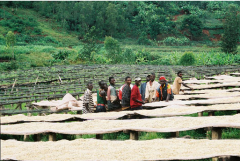
The biggest harvest season for Rwandan coffee is during the main rainy season, from March to the end of May. During the harvest season, farmers spend most of their day picking coffee fruits by hand. In the afternoon, farmers carry coffee fruits in traditional baskets made of banana leaves to a cleaning station a few hours away. The mechanic uses his hands to make the best quality coffee with crimson color.

Rwanda Coffee Production Process Geography Climate
Maraba coffee is grown in southern Rwanda, about 12 km (7 mi) from Butare and 150 km (93 mi) from the capital, Gigali. The project began in the Malaba area of Butare province, but was succeeded by local government organizations in 2006, and the area is now part of the Huye region of Southern province. Due to its proximity to the Great Rift Valley and the Newway Forest Mountains, the terrain of this zone
2017 New Season Burundi Heart of Africa Washed Bourbon Boutique Coffee
Professional barista exchanges, please pay attention to coffee workshop (Weixin Official Accounts cafe_style) Burundi is located in the south of the equator in central and eastern Africa. It borders Rwanda to the north, Tanzania to the east and south, Congo to the west and Lake Tanganyika to the southwest. There are many plateaus and mountains in the territory, most of which are composed of plateaus on the east side of the Great Rift Valley in East Africa. The average altitude of the whole country is 1600 meters, so it is called Mountain Country.

A brief introduction to the Origin, Development, History and Culture of Fruit-flavored Kenyan Fine Coffee beans
Mainly by large farms (Estate) and cooperatives (Cooperatives) two types. The former generally has a large planting area and has independent coffee processing facilities. Most coffee production is done by a large number of small farmers, who form coffee cooperatives. The coffee cooperative society employs special managers to supervise the coffee handling process of its members, even fine enough.

The Story of the Coffee Origin in Kenya: a brief History of Coffee auction in Kenya
Professional coffee knowledge exchange more coffee bean information please follow the coffee workshop (Wechat official account cafe_style) Kenya, the full name of the Republic of Kenya, is located in eastern Africa, the equator runs across the central part of the East African Rift Valley across the north and south. It is bordered by Somalia to the east, Tanzania to the south, Uganda to the west, Ethiopia and Sudan to the north, and the Indian Ocean to the southeast. Multiple plateaus in the territory, average

Introduction to the Flavor and Taste Manor production area of Coffee growing area in Guatemala
Guatemala is located in the tropics, the northern and eastern coastal plains have a tropical rain forest climate, the southern mountains have a subtropical climate, the year is divided into two dry and wet seasons, with the wet season from May to October and the dry season from November to April of the following year. The central plateau is also the cultural center of Guatemala, where temperatures are mild all year round at an altitude of 1300 to 1800 meters, with daily temperatures between 18 and 28 ℃, and higher in January

Coffee production in Vietnam is expected to drop by 20% compared with the plan.
Vietnam's "Economic Times" reported on Sept. 8: the Vietnamese Coffee and Cocoa Association said that coffee production in the 2015-2016 season is likely to fall by more than 20% than planned, which will be the third consecutive coffee season failure in Vietnam. The main reason for the sharp decline in coffee production is the drought and lack of rain in the main coffee producing areas such as Duole, Lintong, Danong and Jialai, and coffee trees withered in a large area. Coffee has the largest planting area.

The production process of Rwandan coffee beans introduces how high-quality Rwandan coffee is produced? Lou
The biggest harvest season for Rwandan coffee is during the main rainy season, from March to the end of May. During the harvest season, farmers spend most of their day picking coffee fruits by hand. In the afternoon, farmers carry coffee fruits in traditional baskets made of banana leaves to a cleaning station a few hours away. The mechanic uses his hands to make the best quality coffee with crimson color.

Fresh coffee scam! Fresh coffee = fresh coffee? You don't understand the tricks behind freshly ground coffee!
Professional coffee knowledge exchange More coffee bean information Please pay attention to coffee workshop (Weixin Official Accounts cafe_style) With the further deepening of consumption upgrading, consumers are becoming more and more mature and picky. Quality replaces price as the most important factor for some consumers. Consumers are increasingly demanding freshness, juice needs to be freshly squeezed, bread needs to be freshly baked, coffee

A brief introduction to the cultivation of spicy and unrestrained boutique coffee beans in Kenya, geographical location, climate and altitude
Coffee cultivation in Kenya is mainly divided into two types: large farms (Estate) and cooperatives (Cooperatives). The former generally has a large planting area and has independent coffee processing facilities. Most coffee production is done by a large number of small farmers, who form coffee cooperatives. The Coffee Cooperative Society hired special managers to supervise the coffee handling of its members.

A brief introduction to the history and culture of the origin and development of Kenyan boutique coffee beans with rich taste
Kenya coffee harvest season there are two harvest seasons in Kenya, the main harvest season is from October to December and the secondary harvest season is from May to July. Large coffee processing farms in Kenya usually have independent processing facilities. A large number of small farmers usually pick ripe coffee fruits by hand. Coffee picking is a labor-intensive job, which requires the whole family to go out or even return during the harvest season.

Start the group like crazy! Huakui 39.9, Yunnan 19.9 half pound free delivery! 29.9 hanging ear combination, Flower Butterfly
"is Qianjie crazy? Here we go again, yes!

Comparison of harvest season and tea taste between Darjeeling black tea and Assam black tea
Tea is a kind of drink that has entered people's way of life. India has become a major producer of this beverage, specializing in a variety of tea and mixed teas-oolong, black, brewing, green and Massala. Now, tea is named according to its origin. Darjeeling and Assam are two very popular tea growers.

In which season of the year is Yejashafi coffee harvested?
In which season of the year, Yejasuefi Coffee is a small town, 700-2100 meters above sea level, which is synonymous with Ethiopian boutique coffee. It has been a wetland since ancient times. The ancient saying "Yirga" means to settle down and "Cheffe" means a wetland. The mode of production and flavor of coffee here are so prominent that Ethiopian coffee farmers compete with their own coffee.

A brief introduction to the treatment method of grinding degree and baking degree of Kenyan boutique coffee beans with rich taste
Coffee cultivation in Kenya is mainly divided into two types: large farms (Estate) and cooperatives (Cooperatives). The former generally has a large planting area and has independent coffee processing facilities. Most coffee production is done by a large number of small farmers, who form coffee cooperatives. The Coffee Cooperative Society hired special managers to supervise the coffee handling of its members.

Taste mellow, neutral Costa Rican Fire Phoenix Manor Coffee flavor production area introduction
The climatic conditions in Costa Rica are very different, completely subverting the classification of the four seasons of the year, there are only two seasons, the rainy season from April to December, and the dry season from the end of December to April of the following year, also known as summer. The annual average temperature in San Jose, the capital, ranges from 15 ℃ to 26 ℃, while the temperature in coastal areas is relatively high, with a night average temperature of 2 in the Caribbean.

How should Kenyan coffee be made by hand at Kasawa processing farm in Enbu county, Kenya?
Professional coffee knowledge exchange more coffee bean information please follow the coffee workshop (Wechat official account cafe_style) in Kenya in 2017, production continued to decline, raw bean prices soared, and there were few winners in the 2017 growing season. The Kasawa processing plant, located in Embu County, was established in 1964. It is a small primary processing plant and village under the Kibugu Valley Cooperative (FCS).

Yega Xuefei aricha coffee beans brewing and sharing Aricha coffee flavor and taste characteristics in 2018 production season
Professional coffee knowledge exchange more coffee bean information please follow Coffee Workshop (Wechat official account cafe_style) Yega Xuefi, a town of about 20, 000 people, adjacent to three small producing areas Wenago, Kochere and Gelena Abaya, because the flavor of the coffee produced is almost no different from that of Yejia Xuefei, so it is divided into Yejasuefei this area. Micro-farmers in high-quality producing areas

Geo-climatic production process of coffee beans in Rwanda
Malaba Coffee grows in southern Rwanda, about 12 kilometers (7 miles) from the city of Butare and 150 kilometers (93 miles) from the capital, Gejali. The plan began in the Malaba area of Butare province, but was taken over by a local government organization in 2006, which is now part of the Huye district of the southern province. Due to its proximity to the East African Rift Valley and the Neuenway Forest Mountains, the terrain